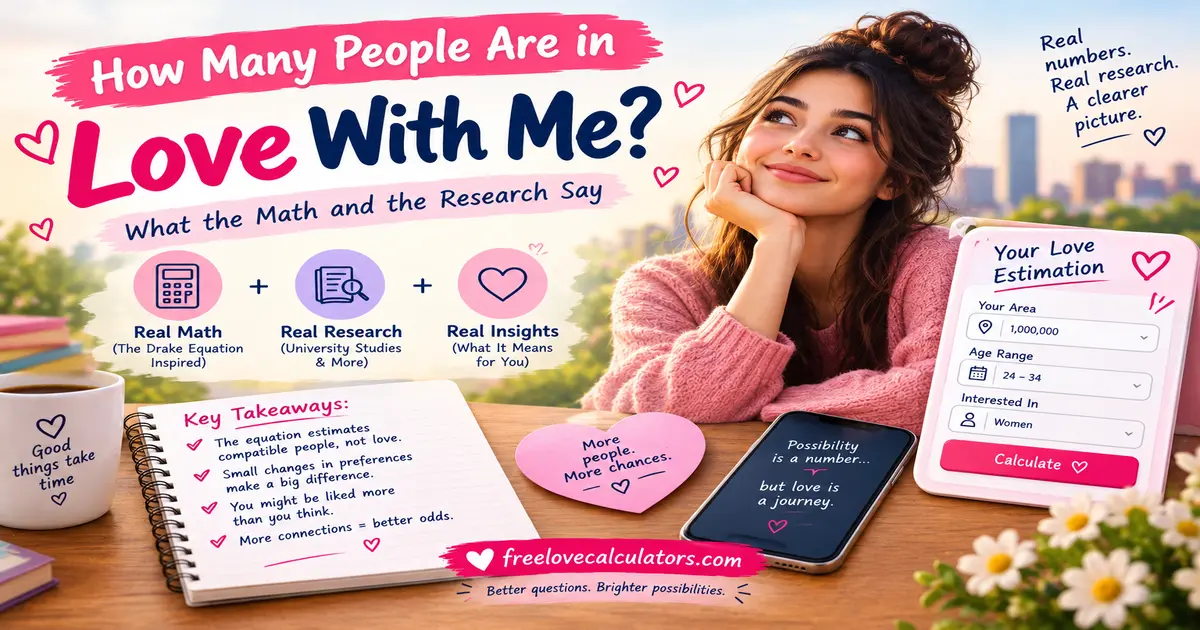
How Many People Are in Love With Me? What the Math and the Research Say
Nobody can count how many people are in love with you, and no quiz or calculator can do it either. What you can do is estimate how many people near you could be a good match, using an equation borrowed from astronomy. Research also shows that people tend to like you more than you think, although liking is not the same as love.
Most people who ask this question are curious, lonely, or hopeful, and each of those feelings deserves a real answer. This guide gives you a tool to estimate your own pool of compatible people and explains what the numbers can and cannot tell you.
How Many People Could Be a Match?
Curious about your possibilities? Adjust the numbers below to estimate how many compatible people might be in your area.
✨ How the Estimate Changes
For education and entertainment only. This tool estimates compatibility, not how many people are actually in love with you.
Can Anyone Count How Many People Love You?
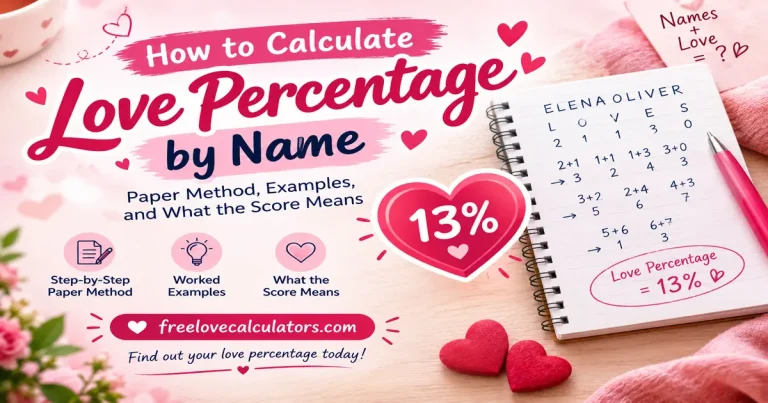
No, because love is a feeling inside another person, and nothing outside that person can measure it. A quiz that promises a number is turning names, dates, or your answers into a score, and the score does not come from anyone's actual feelings.
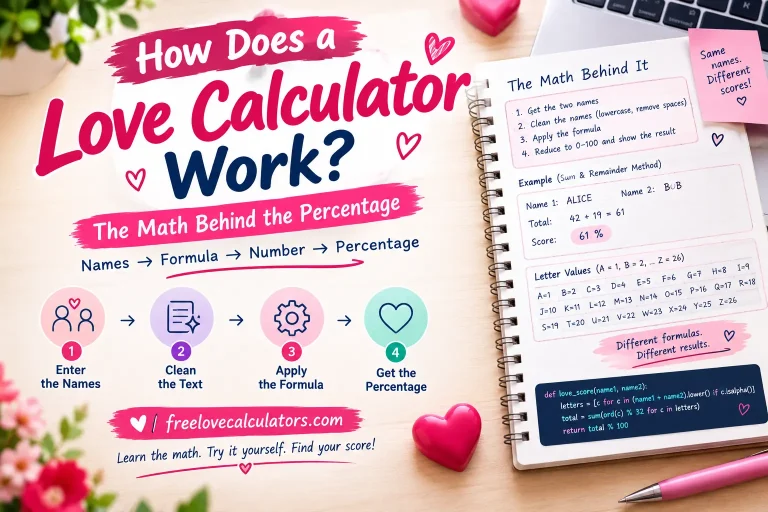
If you are curious how these scores are made, our guide on how these tools work shows the math behind them. The honest question is a different one. You can ask how many people near you could be a good match, and that question has a real method.
The Equation That Counts Possible Partners
In 1961, the astronomer Frank Drake wrote an equation to estimate how many civilizations in our galaxy might be able to communicate. It works by starting with a huge number and multiplying it by a series of fractions.
In 2010, an economics student named Peter Backus at the University of Warwick adapted the idea to love. His paper was called Why I don't have a girlfriend: An application of the Drake equation to love in the UK, and it was written with a pinch of humor.
Backus started with the roughly 30 million women in the UK and narrowed the group step by step. He kept those who lived in London, were aged 24 to 34, and had a university degree, and then he kept those he found attractive.
He then estimated that about 1 in 20 of them would find him attractive, that half were single, and that he would get along with 1 in 10. He ended with about 26 women, and a 1 in 285,000 chance of meeting one of them on a given night out.
In 2013, the University of Warwick reported that Backus had married. The result was a joke about odds, and the odds did not stop him.
How the Estimator Works
The tool above follows the same idea with seven steps. You start with the number of people in your area, and each filter keeps only a share of them.
- Start with the number of people in your area.
- Keep the share in your age range.
- Keep the share who are single.
- Keep the share of the gender you look for.
- Keep the share you would find attractive.
- Keep the share of people who would find you attractive.
- Keep the share you would get along with.
In the equation, the probability of finding a compatible partner for me is simply the number of people who meet every condition divided by everyone in the area. The tool also shows how many new people you might need to meet for a fair chance.
Here is an example with the typical settings. A city of 1,000,000 people drops to 120,000 in your age range, then 60,000 who are single, then 30,000 of the right gender, then 3,000 you find attractive, then 300 who find you attractive, and finally 30 you would get along with.
What Changes the Answer Most
Each filter multiplies the others, so a small change in one percentage moves the final number a lot. The table uses a city of 1,000,000 people and assumes you meet 1,000 new people in a year.
| Setting | People who match | Chance of meeting at least one in a year |
|---|---|---|
| Very picky (5 percent on each of the last three filters) | 3.8 | 0.4 percent |
| Typical (10 percent on each of the last three filters) | 30 | 3.0 percent |
| More open (30 percent on each of the last three filters) | 1,350 | 74 percent |
The lesson is clear in the numbers. Moving from 5 to 30 percent on three filters turned a pool of fewer than four people into a pool of more than a thousand.
What the Estimate Cannot Tell You
The estimator is built to be fun and to teach a lesson about odds. These limits matter before you take any number seriously.
- It counts compatible people and not people who are in love with you.
- It treats each filter as separate, while real preferences overlap and change.
- It counts everyone in your area, even people you will never meet.
- It cannot measure attraction that grows slowly as two people get to know each other.
Think of it as a way to see the shape of the problem and not as a forecast for your life.
People Like You More Than You Think
There is good news in the research. Erica Boothby and her colleagues studied how much people believed their conversation partners liked them, and compared it with how much the partners really did.
Across studies in a laboratory, in college dorms, and at a personal development workshop, people systematically underestimated how much their partners liked them and enjoyed their company. The gap lasted for several months among dorm mates.
The researchers call this the liking gap, and their conclusion is that people are liked more than they know. This is about liking and not romantic love, but it suggests that many people who feel unnoticed are noticed more than they think.
Five Practical Ways to Improve Your Odds
The equation shows that the numbers respond to what you do. These ideas follow from the math and from Backus's own advice.
- Meet more people, because the chance of meeting a match grows with the number of people you meet.
- Spend time in places where people who share your interests gather, which is close to the advice Backus himself gave.
- Loosen one filter, because the table above shows how much a small change helps.
- Ask friends to introduce you, since a friend already knows part of what you would get along with.
- Give a slow connection a second chance, since the estimator cannot see attraction that grows with time.
How to Tell if Someone Actually Loves You
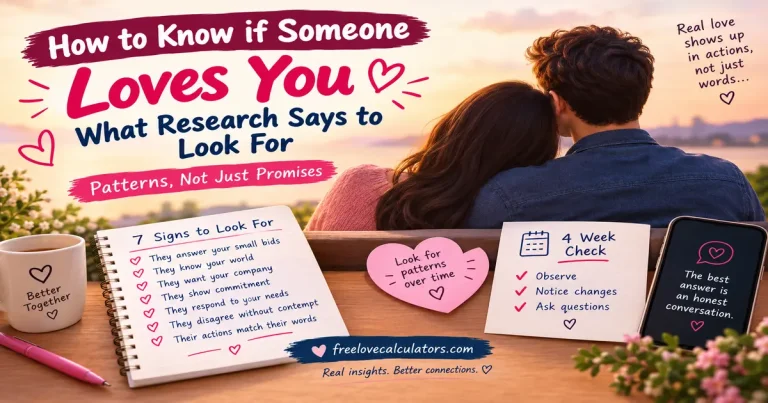
Counting people is a game, and understanding one person is a skill. If you want to know how a specific person feels, our guide on how to know if someone loves you explains the patterns that research points to.
If you would like a playful score for fun, you can try our free love calculator. It is for entertainment only, and it cannot show what any person feels.