How to Know if Someone Loves You: What Research Says to Look For
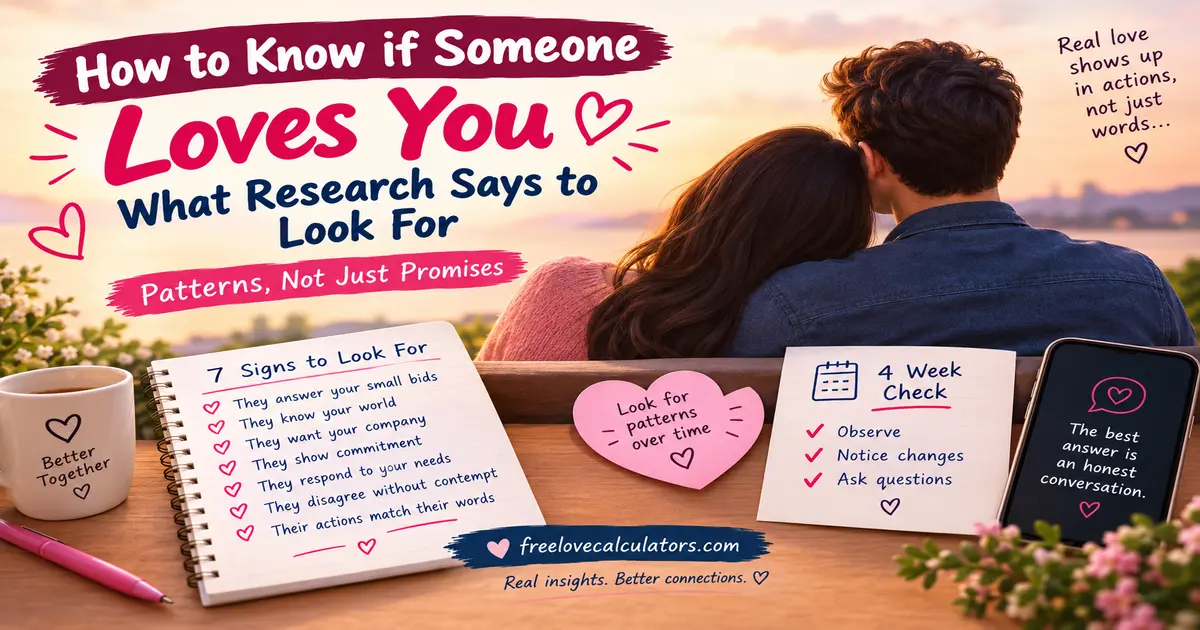
No single sign proves that someone loves you. Research points to patterns over time, such as answering your small attempts to connect, sharing their inner world, showing commitment through actions, and handling disagreements with respect. The surest way to know is to watch for these patterns for several weeks and then ask them directly.
People search this question when a message is unclear or when a relationship has no label. This guide separates what researchers have found from internet folklore, so you can look at patterns and not guess from one text.
What Love Means in Research
Psychologists do not treat love as a single feeling. In 1986, Robert Sternberg proposed that love has three parts: intimacy, passion, and commitment.
In 1970, Zick Rubin studied the difference between liking and loving. His questionnaire described romantic love through a need to be with the person, a wish to help them, and an absorbed focus on them.
These ideas matter because they turn a vague question into observable behaviors. You can notice closeness, attraction, and commitment, and you can notice whether they show up again and again.
Why One Sign Is Never Enough
Many people look for one clear sign, such as a gift or a kind message. The research on love languages shows why that is risky.
A 2024 review found that people rate all five love languages as meaningful, and that there is very little evidence that matching a partner’s favorite language improves satisfaction (Impett, Park, and Muise, 2024). The same review points to responsiveness and a wide range of loving behaviors as the better signal.
In plain words, love tends to show up in many small ways and not in one special way. A single sign tells you little, while a pattern tells you much more.
Seven Patterns to Look For
The table lists seven patterns, what each one looks like, and what research or practice says about it.
| Pattern | What it looks like | What the research says |
|---|---|---|
| They answer your small bids | They look up, reply, or share a joke when you try to connect | Newlyweds who stayed married turned toward 86 percent of these bids, and those who divorced turned toward 33 percent (Gottman Institute) |
| They know your world | They remember your plans, friends, and worries and ask about them | Gottman calls this knowledge a love map |
| They want your company | They make time and seem glad to see you | This matches the passion and closeness parts of Sternberg’s theory |
| They show commitment | They make plans, keep promises, and talk about the future | Commitment was the strongest predictor of satisfaction in one study of 204 adults (Acker and Davis, 1992) |
| They respond to your needs | They notice when you are upset and try to help in different ways | Responsiveness is linked to relationship quality (Impett, Park, and Muise, 2024) |
| They disagree without contempt | They argue about the issue and not about your worth | Gottman Institute research treats contempt, such as mockery or eye-rolling, as a serious warning sign |
| Their actions match their words | What they say and what they do point the same way over time | This is common sense and not a tested item |
The first pattern deserves a closer look. A bid can be as small as saying that the sky looks nice, and turning toward it means answering with interest.
The Gottman Institute describes the 86 and 33 percent figures as coming from a six-year follow-up of newlywed couples. The study looked at married couples, and the same habit of noticing small attempts to connect may also matter in other close relationships.
A Simple Four-Week Check
One good day proves little, so give yourself some time to watch. This check turns the table into a habit.
- Once a week, look at the seven patterns and note which ones you saw.
- Mark each one as rarely, sometimes, or often.
- Look at the change over four weeks and not at any single day.
- Notice which patterns are missing, and write down one question you want to ask.
This is a personal reflection and not a tested scale. Its only job is to help you replace a guess with a record.
Signs That Can Mislead
Some signals feel strong but can have other causes. Keep these in mind before you decide.
- A single fast reply, compliment, or gift, since it may be a one-time kindness.
- A message that says I love you with no change in how the person acts.
- A quiz or calculator result, since those formulas count letters or dates and not feelings.
Calculators and quizzes feel convincing because of a well-known effect. In a classroom study published in 1949, Bertram Forer gave every student the same personality description, and the students rated it about 4.3 out of 5 for accuracy.
How to Ask Directly
After a few weeks of watching, a direct question is often the clearest step. Choose a calm moment, speak about your own feelings, and be ready to hear any answer.
Here are four sentences you can use as they are.
- I enjoy the time we spend together, and I would like to know what this means to you.
- I have noticed that we talk about the future sometimes, and I would like to understand where you see us.
- I like being honest about feelings, so I wanted to tell you how I feel and ask how you feel.
- Can we talk about what we want from each other, so that neither of us has to guess?
An honest answer matters more than a quick one. If the answer is not what you hoped for, you now have real information, which is better than a guess.
When the Answer Is Not Love
Some behavior that looks like attention is actually control. If a person tells you who you can see, threatens you, or makes you afraid, that is not love. If you feel unsafe, talk to a trusted friend or family member, or contact a local support service in your area.
A Playful Way to Start the Conversation
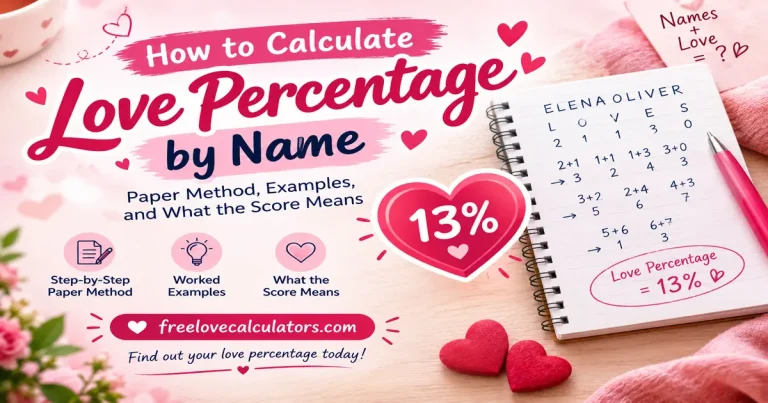
If you want something light while you decide what to ask, our free love calculator and the Love Meter give an instant score from two names. They are for entertainment only, and they cannot show what another person feels.
For the research behind how love is measured, see our guide to how to calculate love percentage, which covers the Rubin and Sternberg studies in more detail.