How to Calculate Love Percentage on Paper: Step by Step With Checked Examples
How this guide was checked: every score was worked out by hand and then confirmed with a short script, and every research claim links to the original journal paper listed in the sources section.
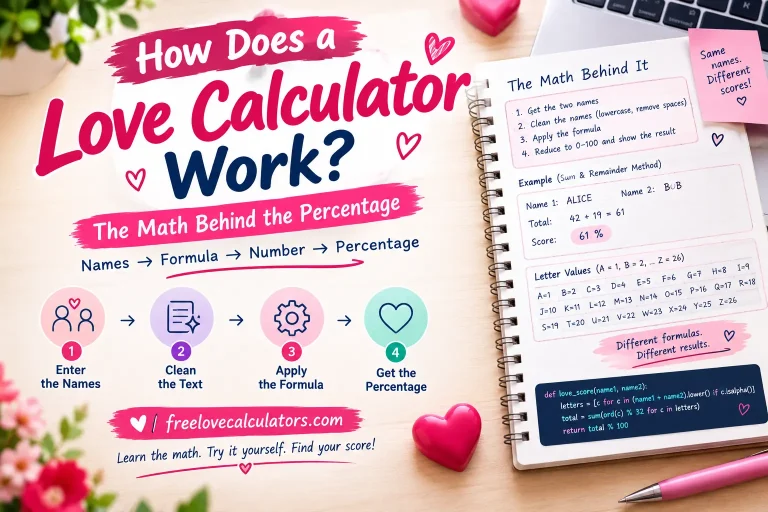
Quick answer: Here is how to calculate love percentage by hand. Write both names together and count how many times the letters L, O, V, E, and S appear. Then add each neighboring pair of counts, keep only the last digit of each sum, and repeat until two digits remain. Those two digits are your score, and because the method only counts letters, the result is a game and not a measure of real feelings.
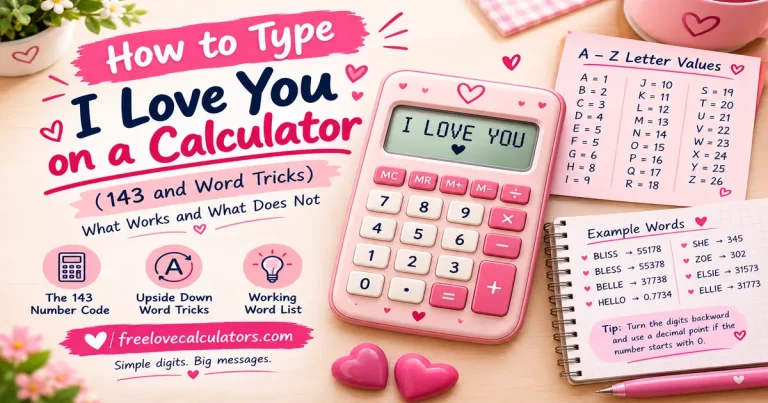
Most people who search this topic want one of two things: either a quick score they can share or the real steps behind the notebook game. This guide covers both, so you can try the online version first or follow the paper steps and check your answer against a worked example. Another playful trick that needs only a calculator is in our guide to typing I love you on a calculator.
How to Find Love Percentage: Three Ways Compared
There are three common ways to get a number or a result for a pair of people, and each one tells you something different.
| Way | What it uses | Time needed | What the result means |
|---|---|---|---|
| Paper method | The letters L, O, V, E, S in two names | About 2 minutes | A game score with no link to real feelings |
| Online name calculator | A formula chosen by each website | About 5 seconds | A game score, and the formula differs by site |
| Honest self-check | Your own answers about closeness, passion, and commitment | About 10 minutes | A personal check-in, not a tested scale |
The first two give you a number to share. The third gives you something you can actually talk about, and it is covered near the end of this guide.
What the Paper Method Counts?
The paper method does not look at personality, age, or birth dates. It only counts how many times a few letters, usually L, O, V, E, and S, appear in the two names written together. Repeated addition then turns those counts into a two-digit number.
Nobody has recorded who invented the game, because it spread by word of mouth between students instead of through a book, so there is no official rulebook. Different pages teach slightly different versions, and the steps below follow one of the most common ones.
How to Do Love Percentage on Paper: The LOVES Method
You need a pen, a sheet of paper, and both names spelled the way they are normally written, with the spaces removed and capital letters ignored. Follow these six steps in order.
- Write both names on one line with no spaces between them, for example ELENAOLIVER.
- On a second line, write the letters L, O, V, E, and S in a row with some space under each one.
- Count how many times each letter appears in the combined names and write the count under it, using only the last digit if a count ever reaches ten.
- Add the first count to the second, the second to the third, and so on along the row, writing each sum on a new line and keeping only the last digit of any sum with two digits.
- Repeat the same addition on the new line, and remember that each new line has one number fewer than the line above it.
- Stop when exactly two digits remain, and read those two digits as your score.
Keeping only the last digit holds every number to a single digit, so the row can keep shrinking until two digits are left. Some pages state this rule clearly, while others leave it out or carry the extra digit instead, which is one reason results differ from site to site.
A Worked Example You Can Check Line by Line
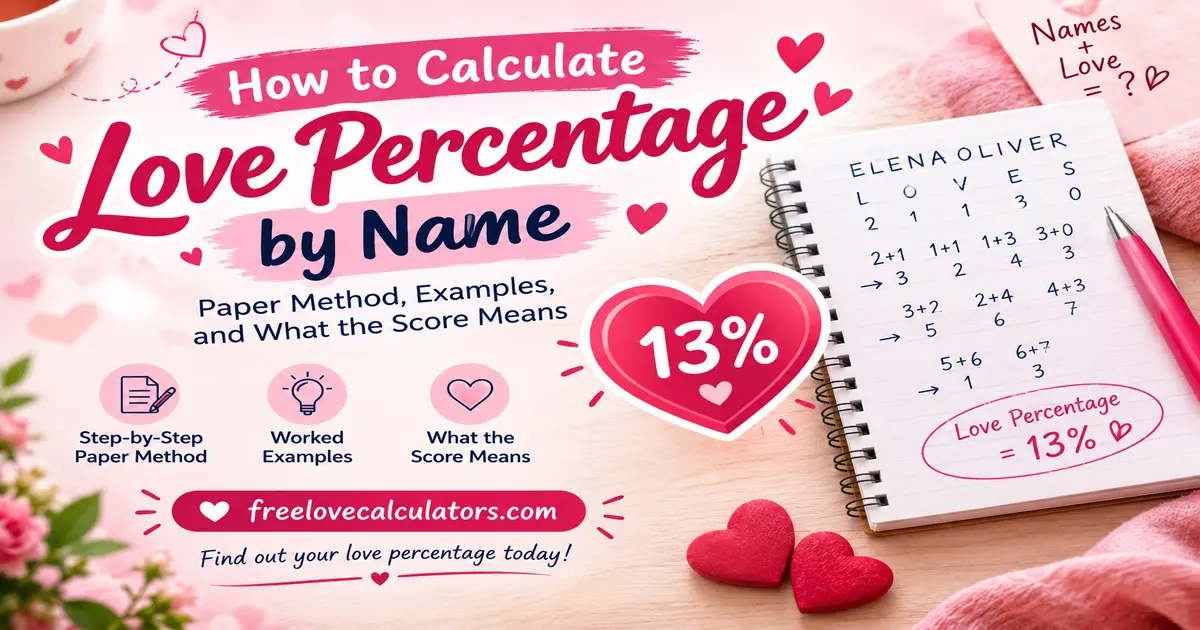
Take the names Elena and Oliver, which become ELENAOLIVER when written together. Elena has one L and two Es, while Oliver has one L, one O, one V, and one E. Neither name has an S, so the counts are two Ls, one O, one V, three Es, and no Ss.
| Line | Numbers | How it was made |
|---|---|---|
| Counts | 2 1 1 3 0 | L, O, V, E, S counted in ELENAOLIVER |
| Second line | 3 2 4 3 | 2+1, 1+1, 1+3, 3+0 |
| Third line | 5 6 7 | 3+2, 2+4, 4+3 |
| Fourth line | 1 3 | 5+6 is 11, so keep 1, and 6+7 is 13, so keep 3 |
On paper, the numbers form a small pyramid, and the last line is your score. Calculators have their own playful tradition too, which our guide to typing I love you on a calculator explains.
L O V E S
2 1 1 3 0
3 2 4 3
5 6 7
1 3
The last line shows 13, so these two names score 13 percent under the LOVES method. That number is low only because the names contain few of the five counted letters, and it says nothing about Elena or Oliver. Sam and Alex score 24 percent and Emily and Jack score 23 percent with the same steps.
Print Your Own Worksheet
Copy this layout onto a sheet of paper and fill it in with any two names.
Print Your Own Worksheet
Enter any two names to calculate your love percentage. Follow the LOVES paper method and print your worksheet.
Try It on Famous Story Couples
The same steps work on any pair of names, including couples from classic stories. Here are six, spelled as shown.
| Pair | Counts for L, O, V, E, S | Score |
|---|---|---|
| Romeo and Juliet | 1 2 0 2 0 | 98 percent |
| Antony and Cleopatra | 1 2 0 1 0 | 85 percent |
| Tristan and Isolde | 1 1 0 1 2 | 56 percent |
| Sohni and Mahiwal | 1 1 0 0 1 | 42 percent |
| Heer and Ranjha | 0 0 0 2 0 | 26 percent |
| Laila and Majnu | 2 0 0 0 0 | 20 percent |
Romeo and Juliet reach 98 percent because their names hold two Os and two Es, while Laila and Majnu score 20 percent because their names hold only two Ls from the five counted letters. The scores follow from letters alone, so they say nothing about how any of these stories ended.
How One Spelling Change Moves the Score
Because only five letters count, spelling matters a lot. Pair Elena with Olivia instead of Oliver and the count of Es drops from three to two, the addition ends at 00, and the score is zero percent.
Common spelling differences do the same. Mohammad and Aisha score 32 percent, but Muhammad and Aisha score 1 percent, because the spelling with a U has no O. Names with none of the five letters, such as Dan and Ian, always end at 00.
The LOVES method can also never reach 100 percent, because it stops at two digits and the largest two-digit number is 99. A page that shows 100 percent is using a different formula.
Other Versions of the Game
The same two names give very different answers depending on the version you use.
| Method | What it counts | Result for Elena and Oliver |
|---|---|---|
| LOVES method | L, O, V, E, S in both names | 13 percent |
| LOVE only method | L, O, V, E in both names | 56 percent |
| TRUE LOVE method | T, R, U, E plus L, O, V, E | 47 percent |
| FLAMES | Letters left after shared letters are crossed out | Enemies |
| Numerology | Letter values added up per name | Name numbers 1 and 9 |
Pick one version and use it for every pair you test. Mixing versions is the most common reason two people get different answers for the same names.
TRUE LOVE test: Count T, R, U, and E in both names together to get the TRUE total. Count L, O, V, and E to get the LOVE total. Write the two totals side by side and read them as the percentage. For Elena and Oliver, TRUE gives 4, and LOVE gives 7, so the result is 47. If either total passes nine, there is no standard rule, which is why the walkthrough above uses the LOVES method.
FLAMES: Cross out the letters the two names share and count what is left, which is seven letters for Elena and Oliver. Counting around the word FLAMES and removing letters ends on E for Enemies. Our FLAMES Love Calculator shows the full steps.
Numerology method: Here, each letter gets a number from 1 to 9 using the Pythagorean chart (A, J, S = 1, B, K, T = 2, and so on up to I, R = 9). Add the letter values in a name and keep adding the digits of the total until one digit is left. Elena adds up to 19, then 1 + 9 = 10, then 1, so her name number is 1. Oliver adds up to 36, then 9. Sites then turn the pair of name numbers into a percentage using their own tables, and these tables differ from one site to the next, so there is no single paper answer for this version.
Is the Paper Method Accurate?
No. The method counts five letters, and the letters in a name say nothing about attraction, trust, or commitment. The score still feels personal because of a well-known effect in psychology.
In a classroom study published in 1949, Bertram Forer gave every student the same personality description, copied from lines in a newsstand astrology book. Students rated it about 4.3 out of 5 for how well it described them (Forer, 1949). It is now called the Forer or Barnum effect, and it explains why a number such as 87 percent can feel made for the two of you.
Researchers measure love by asking people about their own feelings and behavior. Zick Rubin published an early scale in 1970 that separated liking from loving (Rubin, 1970). In 1986, Robert Sternberg proposed that love has three parts, which are intimacy, passion, and commitment (Sternberg, 1986). For lasting compatibility, the Gottman Institute research overview is a better starting point than any letter formula.
Common Mistakes That Change Your Result
- Counting letters from only one name, when the method counts both names together.
- Carrying a two-digit sum instead of keeping the last digit.
- Switching between the LOVE and LOVES versions halfway through, which changes the starting row.
- Changing the spelling or using a nickname partway through.
Calculating It Online Instead
If counting by hand feels slow, our free love calculator runs a name-based formula in about a second and gives the same result every time for the same names. The Love Calculator by Date of Birth and the Zodiac Love Calculator use birth dates and star signs instead of letters, so their results differ. All of these tools are for entertainment only.