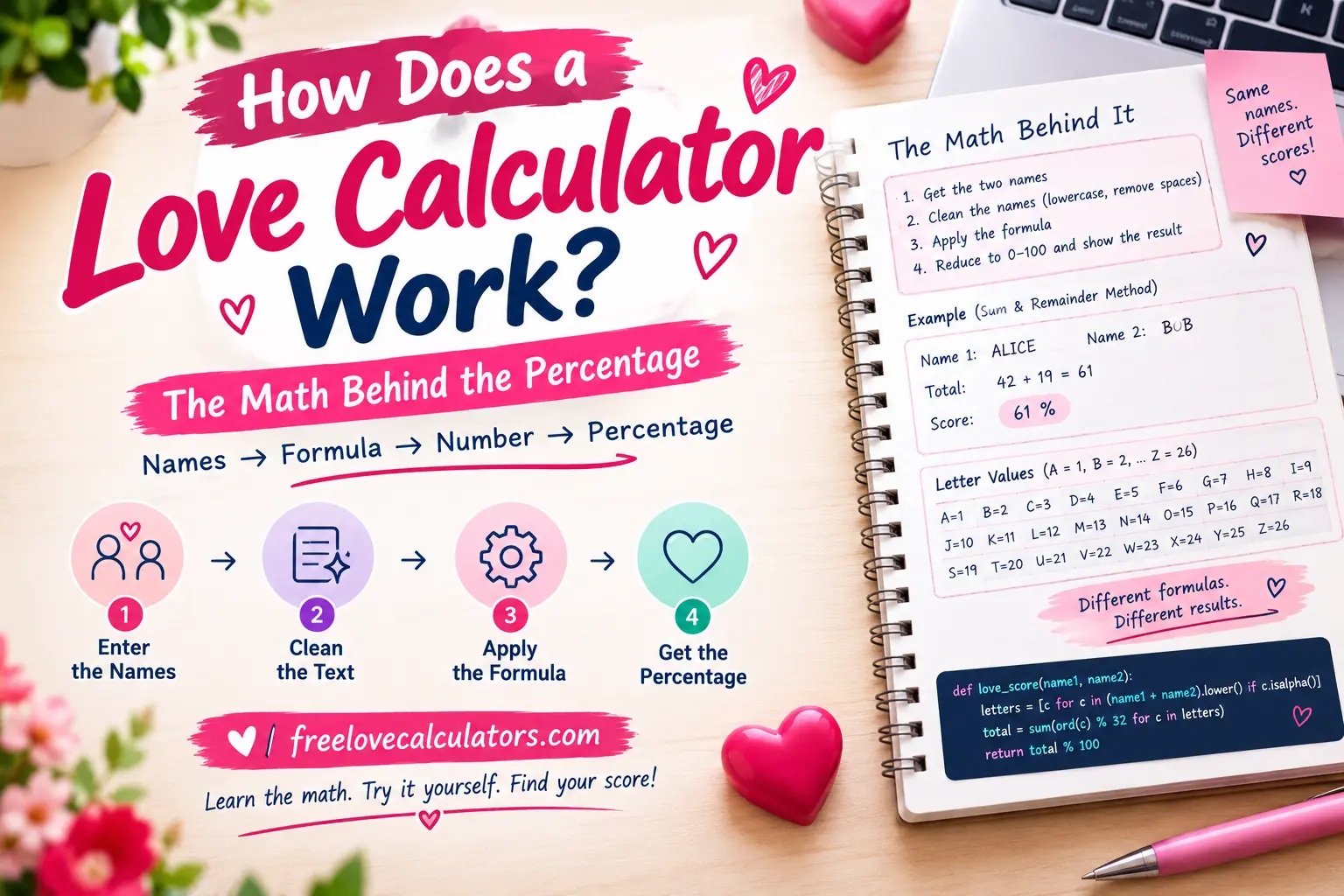
How Does a Love Calculator Work? The Math Behind the Percentage
How this guide was checked: every example was worked out by hand and confirmed with a short script. The code behind a website is not public, so statements about the calculators we reviewed are based on what each one says about itself.
Quick answer: This kind of tool turns the two names you type into numbers, runs them through a fixed formula, and shows the result as a percentage. Most use one of three tricks, which are counting letters, adding letter values and keeping the remainder, or turning the names into a seed for a pseudo-random generator. None of these formulas look at feelings, so the score is entertainment and not a measurement.
Behind the hearts and the progress bar, there are only a few lines of code. This guide shows what those lines do, with a worked example and a short code sketch, and gives you a four-step test to see how any calculator behaves. For signs to look for in a real relationship, read our guide on how to know if someone loves you.
What Happens When You Press Calculate
The process is short, and almost every calculator follows the same four steps.
- The site receives the two names you typed.
- The names are cleaned up, which often means turning letters to lowercase and removing spaces.
- A formula turns the cleaned text into a number.
- The formula reduces the number to a score between 0 and 100 and matches it to a short message.
That is the whole process. Nothing in it asks about the people, their age, or how they feel about each other. To see what math can and cannot say about finding a match, try our compatible people estimator.
Three Formulas Most Calculators Use
Different sites pick different formulas, which is why the same two names can get different scores on different pages. Two of the simplest options take only a few lines of code, and we explain both below.
Letter counting
This is the notebook game moved onto a website. The tool counts certain letters, such as L, O, V, E, and S, or crosses out the letters two names share, as FLAMES does. Our paper method guide shows these steps with checked examples.
Sum and remainder
Each letter gets a number, usually A as 1 up to Z as 26. The tool adds the numbers for both names, divides the total by 100, and keeps the remainder as the score. Because the remainder wraps around, a small change in spelling can swing the score a long way. Later sections show a worked example.
Name as a seed
A hash function turns text into a number, and that number can be used as the seed for a pseudo-random generator. Software documentation explains that setting the same seed produces the same series of numbers every time (PyTorch documentation).
The same names always produce the same seed, so the same names always give the same score. It feels like fate, but it is only repeatable arithmetic. A page can also skip all of this and show a new random number on every click. The test below shows how to spot one.
The Whole Idea in Five Lines of Code
Here is the sum and remainder method written in Python, which shows how little code a calculator needs. This is a sketch of the method and not the code of any particular site.
💕 Love Percentage Calculator
Enter two names to calculate their love percentage using the sum-and-remainder formula.
This percentage is for entertainment only and does not measure real love or relationship compatibility.
The function joins the two names, keeps only the letters, turns each letter into its number, adds them up, and returns the remainder after dividing by 100. We ran it on the examples in this guide, and it matches the hand calculations below.
How Different Calculators Handle Name Order and Score Range
Calculators that explain their method in writing do not agree with each other. We reviewed four, and the table lists what each one says about itself. We did not inspect their code.
| Calculator | Does name order matter? | Score range it describes |
|---|---|---|
| A | No, names are sorted alphabetically first | 5 to 100 |
| B | No, names are combined alphabetically | 0 to 100 |
| C | No, either order gives the same score | Not stated for the main score |
| D | Yes, swapping the order gives a different result | Not stated in the text we read |
The first row is worth a second look. A page that never shows a score below 5 has chosen a floor for the result, which is a design decision about how the number feels and not a fact about two people.
A Four Step Test for Any Calculator
You can learn a lot about a page in about two minutes with a few quick checks.
- Enter the same two names twice. If the score changes, the page uses random numbers.
- Swap the order of the names. If the score changes, the formula depends on order.
- Change one letter or try a nickname. A big jump shows how fragile the formula is.
- Try ten different pairs and note the lowest score. If you never see anything under 5 or 10, the page probably limits its range.
How to Do the Name Compatibility Test Yourself
You can run the sum and remainder method on paper with the table of letter values below.
💗 A–Z Love Calculator Letter Values
Every letter has a number from 1 to 26. Use this chart to calculate the numerical value of a name.
| Letter | Value | Letter | Value | Letter | Value |
|---|---|---|---|---|---|
| A | 1 | J | 10 | S | 19 |
| B | 2 | K | 11 | T | 20 |
| C | 3 | L | 12 | U | 21 |
| D | 4 | M | 13 | V | 22 |
| E | 5 | N | 14 | W | 23 |
| F | 6 | O | 15 | X | 24 |
| G | 7 | P | 16 | Y | 25 |
| H | 8 | Q | 17 | Z | 26 |
| I | 9 | R | 18 | — | — |
- Write each name and put the value of every letter under it.
- Add the values for the first name, then add the values for the second name.
- Add the two totals together.
- Divide by 100 and keep the remainder, which is the same as the last two digits of the total.
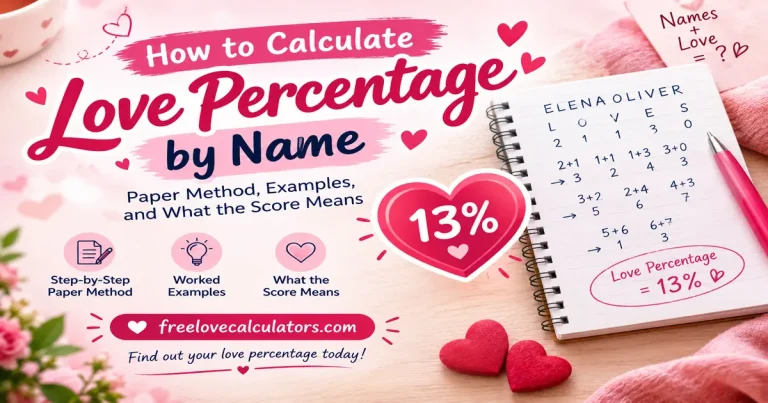
For Elena, the letters E, L, E, N, and A add up to 37. For Oliver, the letters O, L, I, V, E, and R add up to 81.
The two totals make 118, and the last two digits give a score of 18 percent.
What One Spelling Change Does
Swap Oliver for Olivia and the second total drops from 81 to 68, because the letters E and R are replaced by I and A. The combined total becomes 105, and the score falls from 18 percent to 5 percent.
The same thing happens with common spelling differences. Mohammad and Aisha score 6 percent, while Muhammad and Aisha score 12 percent, and both spellings of the name are in everyday use. Order does not matter in this method, because addition gives the same total either way. Sam and Alex score 75 percent, and Alex and Sam also score 75 percent.
Why the Result Feels Personal
A fixed score still feels like it was made for you because of a well-known effect in psychology. In a classroom study published in 1949, Bertram Forer gave every student the same personality description, and the students rated it about 4.3 out of 5 for accuracy (Forer, 1949).
Many calculators add to this by attaching a stock message to each score band. Everyone who lands in the same band reads the same words, and each reader tends to fit the message to their own situation.
What a Name-Based Formula Cannot See
A formula built from letters has no way to see the things that researchers study when they ask what makes relationships work.
- How close two people feel in daily life, which Robert Sternberg calls intimacy (Sternberg, 1986).
- How strongly they are drawn to each other, which he calls passion.
- How committed each person is, which one study found to be the strongest predictor of satisfaction (Acker and Davis, 1992).
- How the two of them handle disagreements, which is the focus of Gottman Institute research.
- Whether they want similar things from money, family, and where to live.
Our paper method guide covers these studies in more detail and includes five prompts you can use to talk about them.
Red Flags on Calculator Sites
Most calculators are harmless fun, but a few habits are worth watching for.
- The page asks for an email address or phone number before showing the result.
- The page claims the score is scientific or 100 percent accurate.
- The result is hidden behind an app download, a payment, or a long chain of ads.
- There is no privacy policy or contact page.
A name formula needs nothing more than the names or dates it uses, so a page that asks for more is collecting something it does not need to give you a score.
What Happens to the Names You Type
Some calculators work inside your browser, while others send your input to a server. The privacy policy of the page should say which one it is and whether names are stored.
If a page does not explain this, use nicknames instead of full names. You can read how this site handles the names you enter in our Privacy Policy.
Machines Before Websites
The idea of a machine rating romance is older than the internet. Arcade love testers rated people by measuring skin response or by showing a random number, and neither method measured love. Our Love Meter page explains that history in more detail.